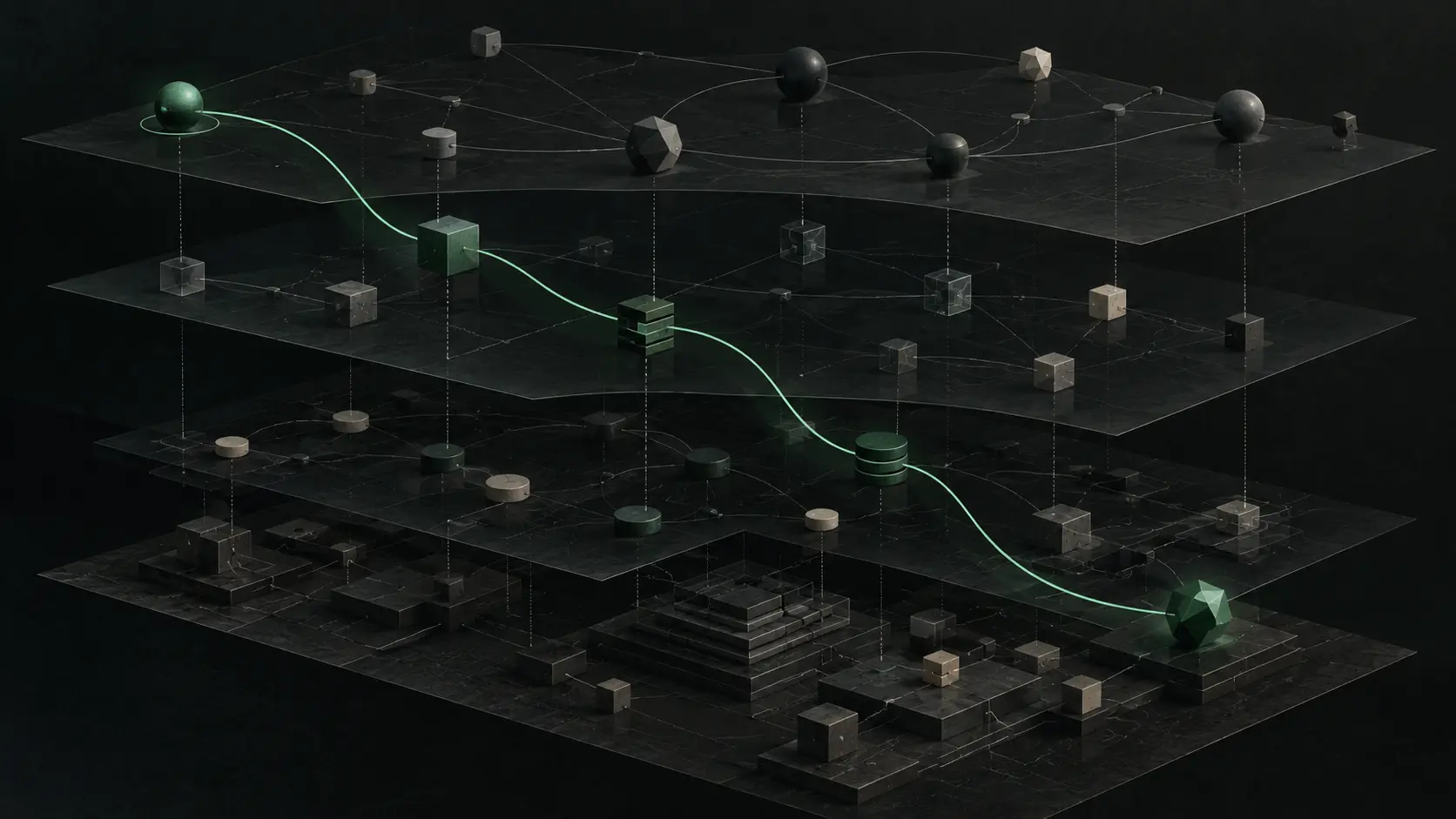
On September 17, 2026, Anthropic published new information about the internal AI-agent infrastructure used in its research and engineering work.
The headline number was striking: Anthropic reported roughly 30,000 concurrently operating research and engineering agents on its most heavily used internal platform. Source ↗
But one architectural detail may be more consequential.
Anthropic says each agent has an individual identity, and that data created by that agent is associated with that identity. Crucially, the identity is not tied to the particular underlying model.
That means an agent’s historical record can remain continuous even when the model powering it is upgraded. Source ↗
This distinction begins to separate two concepts that are often treated as the same thing:
The modelprovides the underlying capabilities.
The agentmay accumulate history, actions, relationships, delegated work, and provenance over time.
Anthropic also describes agents communicating through a shared messaging system in which messages remain linked to their originating agent identities and transcripts. According to Anthropic, this allows agents to treat another agent’s output as an external claim that can be checked rather than simply absorbing it as their own reasoning. Source ↗
That is not merely a convenience for distributed software.
It suggests that identity and provenance may become part of the control architecture for persistent AI systems.
From model governance to agent governance
Most AI governance frameworks have historically centered on the model:
- Which model generated an output?
- Which version was deployed?
- What evaluations did that model pass?
- What safeguards apply to it?
Persistent agents introduce additional questions.
If an agent operates over weeks or months, delegates work, communicates with other agents, and continues operating through model upgrades, accountability may require preserving more than the identity of the model that happened to execute a particular step.
A robust record may need to establish:
- which persistent agent performed an action;
- what information it possessed at that time;
- which permissions and authority it held;
- which claims originated from other agents;
- what model version powered it during a particular action;
- what changed after a model upgrade;
- and whether its behavioral and decision history can still be reconstructed.
In other words, the model may become only one component of a longer-lived computational identity.
Provenance as control infrastructure
This also changes the meaning of provenance.
In short-lived AI interactions, provenance can look like logging: a record retained mainly for debugging or post-hoc review.
In persistent multi-agent systems, provenance can serve a more fundamental function.
It can define who produced a claim, which system relied on it, whether authority was delegated, and how a decision propagated through a network of agents.
Anthropic’s description of inter-agent messages retaining their originating identity is particularly interesting for this reason.
A claim received from another agent can remain visibly external rather than silently becoming part of the receiving agent’s own internal history.
That separation could matter for verification, error containment, responsibility tracing, and later audit.
Scale makes the problem harder
Anthropic also described extensive monitoring of this internal agent population.
The company reported 100% pre-action monitoring coverage on the platform and said approximately 0.002% of more than one billion decisions during August were blocked by that monitoring system. It also performs retrospective monitoring of agent activity. Source ↗
Those figures should not be interpreted as evidence that large-scale agent oversight has been solved.
Anthropic itself emphasizes that its experience monitoring systems at this scale is still relatively recent and that the science of understanding large populations of agents remains immature.
That caveat may be the most important part.
As AI systems move from isolated conversations toward persistent, delegated, and interacting processes, governance increasingly becomes a systems problem rather than only a model-alignment problem.
Primary source